CPA Pearland AlternativeThe return follows the till
The return on the 20th asked which county, and nobody at the register knew. The return due on the 20th should name the county the register used. A blended guess is not a filing.
Ask about the 20th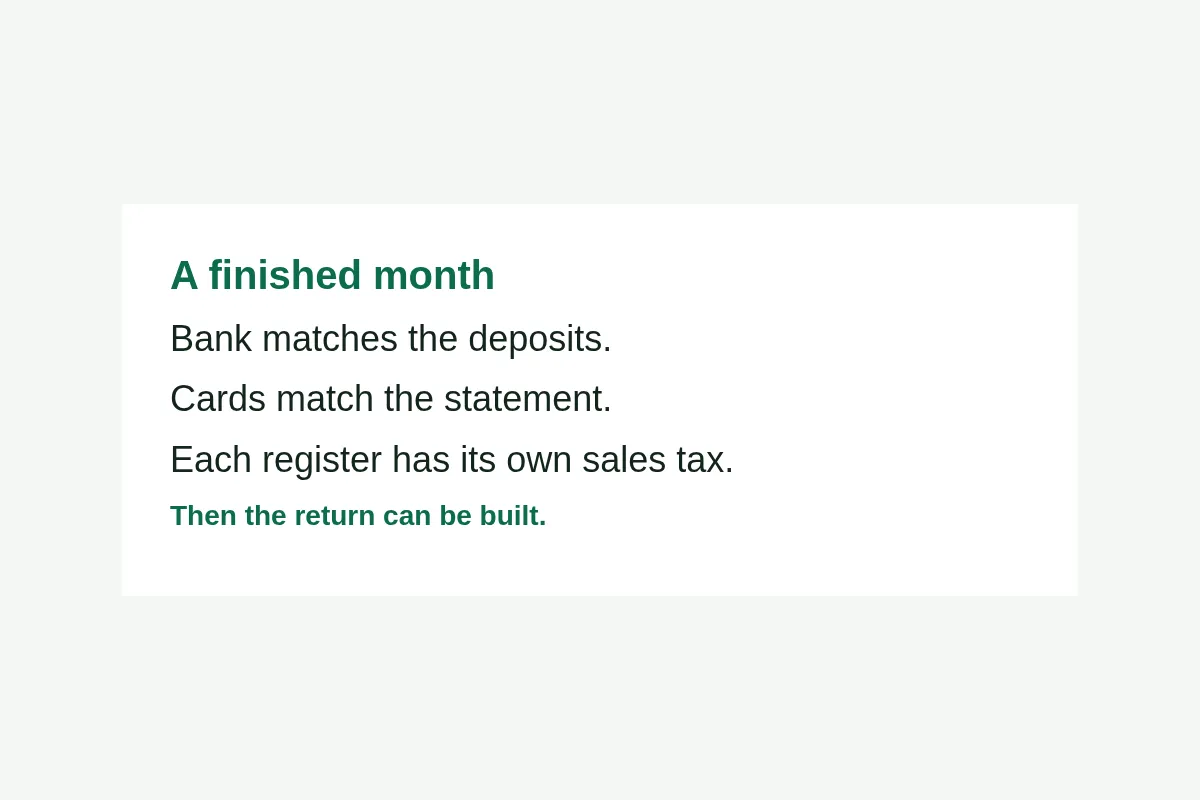
What has to be true before the return is built.
The month is closed when the bank matches, the cards match, and the tax collected matches the register report for each location. If any of those three is still a pile, the return waits. A return built on an open month is a story we will not sign.
The report we want is boring. Location, taxable sales, total charged, tax collected. Boring is the result. A dramatic reconstruction on the 19th means the month was never closed, and the drama belongs to the next cycle only if we say so out loud.
Owners sometimes ask us to file from the bank deposits alone. Deposits mix tax, tips if you have them, loan proceeds, and owner money. The register report is the document. The bank is the check on it. Neither one replaces the other.
We keep the city piece and the county piece visible even when the customer saw one combined number. The Comptroller's return is happier when the local codes match the locations. Code 2020024 is the city. Code 4020006 is the Brazoria county piece. The management district codes, when they apply, are 5101650 and 5101696. A worksheet that keeps them apart is how the 20th stays boring.
A Saturday that lands on Monday.
A fair weekend, a playoff Friday, a Saturday that filled the town center, all of them tend to hit the bank on Monday. The deposit belongs to the weekend. If it is booked whenever someone gets to it, the return and the month both drift, and a quiet week inherits a loud one's tax.
We date the deposit to the day it was earned and the return to the month. Those two dates are allowed to be different. They are not allowed to be vague.
A Monday that still adds up is the relief an owner actually wants. We want that relief to be real. The wink is a return that matches the drawer, not a return that matches someone's memory of the drawer.
Contractors who staff a busy week and shops that feed them have the same problem in different clothes. Per diem and a fat deposit can land in the same fortnight. The sales tax piece is still not revenue, and the labor is still not a miscellaneous pile. We give each a name that can be compared with the next busy week.
After the 20th, the year is still open.
Filing on time is not the same thing as knowing whether the year is on track. Estimates that were set by dividing last year's bill into four will miss a year whose collections changed, or a year that simply got larger. The underpayment shows up later, usually in April, with a tone nobody enjoys.
The next estimate listens to the year we are in, and last year is only a reference. If a till moved between 7.75 and 8.25, the sales tax moved and the profit may have moved with it. April should not be the first time the estimate hears about that.
Contractor names for the 1099s belong on that same calendar. A busy week that never wrote the name or the amount down turns into a January scramble. We ask for those names while the weekend logs are still in the drawer. That is record keeping beside the setup. It is not a Friday we run.
The old center of town, where Main meets Broadway, still feels like the place a receipt would have been written by hand. A corner that remembers being a town deserves a modern receipt that names the county. We respect that corner from a video call, and we still want the receipt to say which county it was printed in.
Tell us where the 20th stands

You will be talking to the Steven Palmieri practice.